
Stay updated with our latest insights
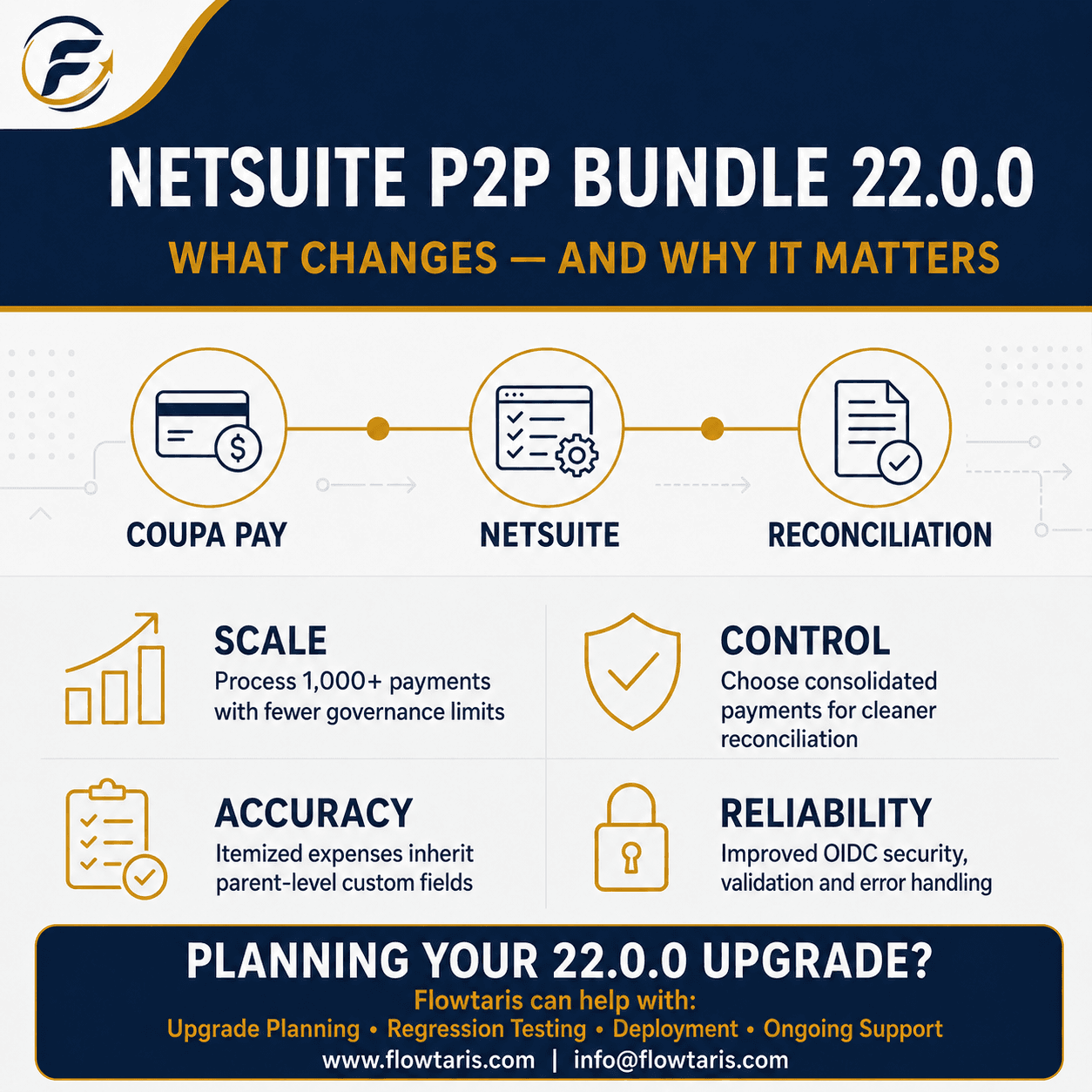
NetSuite P2P Bundle 22.0.0: Key Changes, Business Impact and Upgrade Checklist
Explore the major NetSuite P2P Bundle 22.0.0 improvements for Coupa Pay, expense processing, vendor synchronization and OIDC authentication—and what organizations should test before upgrading.
NetSuite P2P Bundle 22.0.0: Key Changes, Business Impact and Upgrade Checklist
Explore the major NetSuite P2P Bundle 22.0.0 improvements for Coupa Pay, expense processing, vendor synchronization and OIDC authentication—and what organizations should test before upgrading.

NetSuite Release Management: What Growing Companies Often Get Wrong
Growing businesses often underestimate the complexity of managing NetSuite’s twice-yearly releases. Upgrades introduce new features and potential disruptions: scripts break, workflows change, and integrations falter. The real problems usually aren’t the software itself but gaps in process and governance. In practice, companies treat releases as an afterthought—skipping sandbox testing, lacking an "owner," and overlooking change management. This creates hidden costs and risks: missed deadlines, frustrated users, compliance issues, and expensive emergency fixes. The software isn’t at fault – release failures come from lack of preparation. Many companies treat NetSuite upgrades as "something to get through" instead of planning for them. They often skip thorough testing, fail to manage customizations, and don’t allocate ownership or resources. The result: last-minute firefighting when the system inevitably changes. By contrast, a formal release management process (with sandbox testing, documented changes, and clear roles) turns these upgrades into predictable events. In short, the mistakes aren’t technical but procedural.

Coupa Upgrade Best Practices: How to Avoid Business Disruption
Upgrading Coupa – the leading cloud-based procurement and spend management platform – is essential for unlocking new features, tighter controls, and compliance updates. Yet, every upgrade carries the risk of business disruption if not carefully managed. Our experience shows the problems usually stem not from the technology itself, but from gaps in planning, integration, testing, and change management. For example, dozens of new features in Coupa’s R44 and R45 releases required enterprises to adjust encryption settings, opt in to AI-driven functions, and re-test all data exchanges. Without advance planning, these changes can break file integrations, halt invoice processing, or confuse end users. To upgrade Coupa without derailing operations, organizations must treat each Coupa upgrade like a mini-implementation: set up clear governance, map out the release schedule, and use Coupa’s sandbox environment for a full regression test of every business process. Audit and update all integrations (APIs, cXML, file transfers), and train your finance and procurement teams on any changed workflows. With rigorous preparation and experienced partners, even a major Coupa upgrade can go live with zero business disruption.

How to Build an Audit-Ready ERP System Without Operational Bottlenecks
Organizations today face a two-sided challenge in ERP transformation: they must satisfy auditors with rigorous controls while keeping business processes fast and efficient. Achieving audit readiness (for example, SOX-compliant workflows and transparent data trails) often requires adding checks and governance layers – steps that can inadvertently slow down operations if handled poorly. By designing audit controls into the system from day one and following disciplined implementation practices, organizations can build secure, scalable, and audit-ready ERP solutions without creating frustrating bottlenecks. Building an ERP system means unifying finance, procurement, HR and other processes into a single platform. This promises visibility and efficiency, but the integration also raises the stakes: every process step must meet compliance rules and audit trails. CFOs and compliance officers insist on strict controls, but business managers demand that workflows remain smooth and uninterrupted. The tension is real: without the right balance, overbearing controls can grind processes to a halt, while too much “ease” can compromise compliance.

How Coupa Helps Reduce Spend Leakage and Improve Procurement Control
Uncontrolled or maverick spend can silently erode up to 10–20% of a company’s procurement savings, according to procurement analysts. In practice, this often happens when employees buy outside approved processes or suppliers, leading to lost discounts, compliance risk, and budget overruns. Every organization faces unintended spend leakage — dollars that flow outside procurement’s sight and control. This happens when approved processes aren’t followed: staff buy from unapproved vendors, issue payments without contracts, or simply bypass cumbersome systems under deadline pressure. Coupa’s cloud-based Business Spend Management (BSM) platform tackles spend leakage by unifying the end-to-end procure-to-pay process. By centralizing purchasing, approvals, invoicing, and expenses on a single platform, Coupa provides real-time visibility into all spend and enforces policy at the point of purchase. Leading companies already use Coupa to harden procurement controls. For example, Deliveroo centralized its previously fragmented procurement into Coupa and immediately cut off off-contract purchases. Fintech leader Revolut now processes 80% of its global spend through Coupa, gaining the visibility and compliance controls to prevent rogue spend. However, implementing Coupa is not just a technology project. It requires solid data governance, clear ownership of supplier and budget data, and strong change management. When procurement teams, business units, and IT collaborate early — for example, agreeing that the ERP will be the "master" vendor record and Coupa the buying engine — companies get the full benefit and turn routine purchases into a strategic advantage.

Accounts Payable Automation: Why Leading Finance Teams Are Going Beyond Invoice Processing
Finance teams today are rethinking traditional AP automation. Instead of treating accounts payable as an isolated invoice-scanning task, top organisations are integrating it into the full source-to-pay (S2P) workflow. By linking invoices to supplier onboarding, purchase orders, payments, and contracts, they gain real-time insight into spending, enforce stronger controls, and unlock strategic value across the business. Traditionally, AP automation was sold as a narrow invoice-capture solution: scan a PDF, match it to a PO, and route it for approval. But the leading finance teams now see AP automation as the foundation of broader S2P orchestration. In this vision, information flows seamlessly across systems. For example, a new supplier added to the master data is immediately available for invoice routing; a PO raised in procurement triggers an approval path and a matching invoice entry in the general ledger. When properly integrated, AP automation transforms efficiency — quadrupling invoice throughput per staffer — and security, shifting finance teams from manual clerical tasks to strategic cash management. However, implementing this vision is complex, and many projects stumble on poor data, broken processes, and weak change management.